Recently, significant interpretative discrepancies have emerged in Poland regarding the scope of ADR exemption 1.1.3.6, in particular in relation to the obligation to appoint a Dangerous Goods Safety Adviser (DGSA) and to submit the annual report.
This article provides a concise analysis of the issue based on the provisions of the Agreement concerning the International Carriage of Dangerous Goods by Road (ADR), the Polish Act of 19 August 2011 on the Carriage of Dangerous Goods, the Regulation of the Minister of Infrastructure amending the regulation on the annual report form for activities involving the carriage of dangerous goods and the method of completing it, as well as positions issued by national authorities and the professional DGSA community.
Nature and Scope of ADR Exemption 1.1.3.6
ADR provision 1.1.3.6 introduces a so-called quantity-based exemption, allowing certain ADR requirements to be waived when dangerous goods are carried in quantities not exceeding specified limits per transport unit (e.g. 20/50, 333, 1000, or unlimited – depending on the transport category).
Key interpretative doubts arise from the fact that:
- the wording of 1.1.3.6 does not explicitly limit its application solely to carriage in packages; it does not expressly exclude other modes of carriage, particularly 1.1.3.6.3, which refers only to quantities carried per transport unit;
- at the same time, certain obligations (e.g. orange plate marking) remain independent of quantity limits.
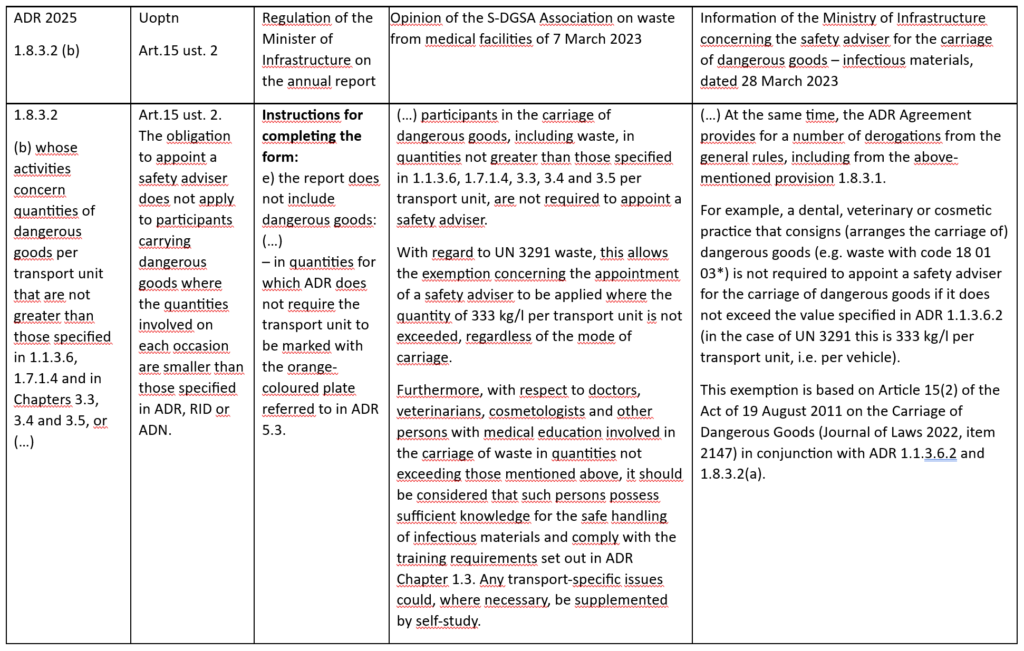
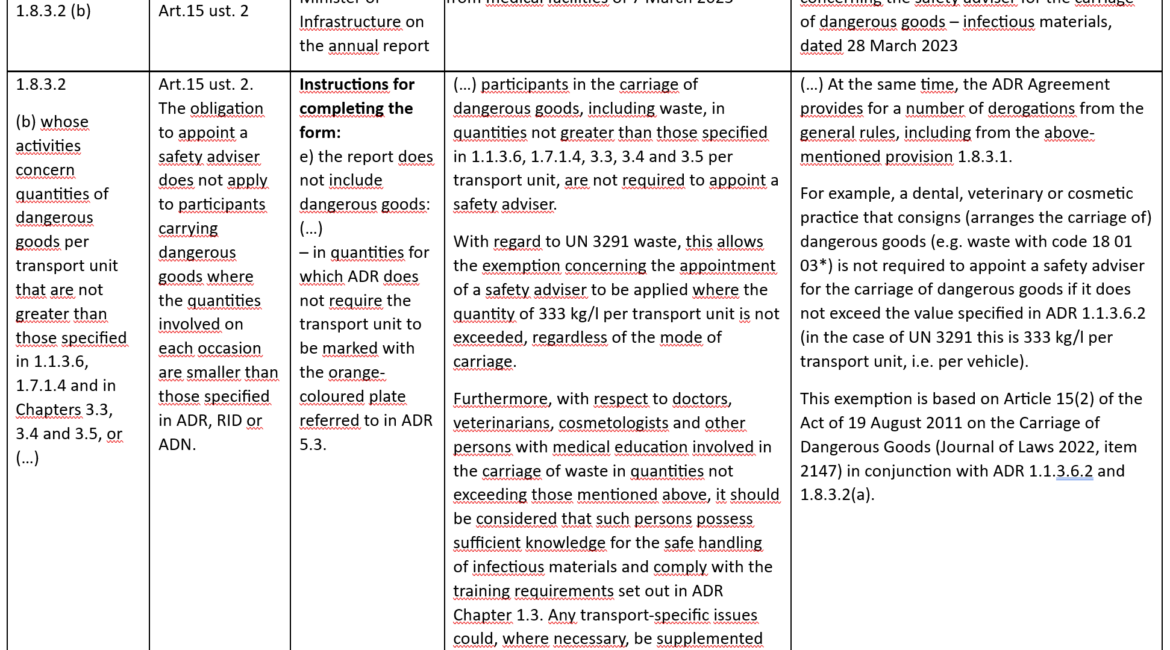
Particular importance attaches to ADR 2025 provision 1.8.3.2 (b), according to which the obligation to appoint a safety adviser does not apply to undertakings whose activities concern quantities per transport unit that are not greater than those specified in 1.1.3.6, 1.7.1.4 and Chapters 3.3, 3.4 and 3.5.
Article 15(2) of the Polish Act – Alignment Issue with ADR
Article 15(2) of the Polish Act on the Carriage of Dangerous Goods uses the wording:
“in quantities smaller than those specified in ADR, RID or ADN”.
However, since ADR 2019, provision 1.8.3.2 was amended from “smaller than” to “not greater than”, which has both logical and systemic significance.
The lack of alignment of the national provision with the current ADR wording results in:
- ambiguity regarding the scope of the exemption,
- risk of divergent interpretations,
- difficulties in enforcement practice.
It would therefore be justified to consider clarifying Article 15(2) by explicitly referring to quantities “not greater than those specified in ADR” and clearly indicating whether the exemption applies to all modes of carriage (packages, bulk, tanks).
Annual Reporting and Vehicle Marking
Following the amendment of the Regulation of the Minister of Infrastructure of 2 June 2022 concerning the annual report form, the following rule was introduced:
the report does not include dangerous goods in quantities for which ADR does not require the transport unit to be marked with orange plates (ADR 5.3).
This has significant practical consequences:
- in the case of carriage in packages under 1.1.3.6 – no obligation to mark the vehicle → no obligation to include such operations in the annual report;
- in the case of carriage in bulk or in tanks – the marking obligation always applies, regardless of quantity → an obligation to include such activities in the annual report arises.
As a result, a situation is possible where:
- an undertaking is not required to appoint a safety adviser (due to 1.1.3.6),
- but is still required to prepare an annual report.
This solution appears systemically inconsistent and raises serious interpretative concerns.
Position of the Professional Community and the Ministry of Infrastructure (UN 3291)
In March 2023, the following were published:
- an opinion of the S-DGSA Association,
- information from the Ministry of Infrastructure concerning infectious substances (including UN 3291).
According to the Ministry’s information, if the value specified in ADR 1.1.3.6.2 is not exceeded (for UN 3291 – 333 kg/l per transport unit), there is no obligation to appoint a safety adviser.
Importantly, this information does not differentiate between modes of carriage (packages, bulk). In practice, this implies that the quantity criterion prevails over the mode of carriage.
At the same time, carriage in bulk and in tanks still triggers the obligation to mark the transport unit, and therefore potentially the reporting obligation.
Practical Consequences – Examples
Example 1
Consignment in a tank of waste UN 3082 (transport category 3) in a quantity of 1000 litres.
- no obligation to appoint a safety adviser (according to the Ministry’s interpretation),
- obligation to mark the tank with orange plates,
- obligation to prepare an annual report for the activity “consignment”.
Example 2
Consignment in bulk of waste UN 3509 (transport category 3) in a quantity of 1000 kg.
- no obligation to appoint a safety adviser,
- obligation to mark the vehicle,
- obligation to prepare an annual report for the activities “consignment” and “filling”.
In both cases, the DGSA obligation and the reporting obligation are separated.
Need for Clarification of National Provisions
The current situation indicates the need to:
- harmonise the wording of Article 15(2) of the Polish Act with ADR 1.8.3.2;
- clearly determine whether the quantity-based exemption applies to all modes of carriage;
- consistently link the obligation to appoint a safety adviser with the obligation of annual reporting;
- consider introducing a systemically transparent provision (e.g. explicitly stating whether the exemption applies to carriage in packages, bulk and tanks – if that is the legislator’s intention).
Further Action at International Level
Given the importance of the issue, the interpretation of 1.1.3.6 in the context of 1.8.3.2, initiated by ESD ADR, has been referred – via IASA (International Association of National Associations of Safety Advisers) – for discussion at international level within the framework of the United Nations Economic Commission for Europe (Joint Meeting of the RID Committee of Experts and the ADR Working Party), scheduled to take place in Bern on 24–27 March 2026.
It is therefore possible that, in the coming years, clarification will be introduced at ADR level, which should subsequently be reflected in national legislation.
Conclusions for DGSAs
- At present, the correct assessment of quantities per transport unit is crucial.
- The following obligations should always be assessed separately:
- the obligation to appoint a safety adviser,
- the obligation to mark the vehicle,
- the obligation to prepare the annual report.
- In ambiguous cases (such as Examples 1 and 2), it is recommended to document the adopted interpretation.
The problem is systemic in nature and requires further legislative clarification. However, it already directly affects the practice of entities operating, for example, in the medical waste and industrial waste (e.g. waste oils) sectors.